Wednesday, May 8, 2013


Saturday, May 4, 2013
Tuesday, April 30, 2013
Learn About The Herring
Well I guess the U.N. actually has contributed something good to the world for once -- useful information about herring!!!!!
| |||

Introduction
This note summarizes some useful background information about the herring for
those in the industry who want to know more about this important commercial
species.
Common, scientific and foreign names for herring are given, together with information on size, weight, life history and geographical distribution. The capture and landing of herring are briefly described, and there are notes on processing, distribution and marketing.
The name herring is used in other parts of the world to describe a number of species similar in appearance to the Atlantic herring.
Many local names have been applied in the past to herring, often to indicate size or condition, but most of these are now little used or obsolete. Examples are Dunbar wedder, nun, peeo, scadan, scattan, sgadan and sild. The names shaldoo, shaltoo, sile, yaulin’ and yawling have been used for small herring, and the names torn belly and wine drinker have been used to describe condition. In addition there are several names, originating from the old Crown Brand system of marking barrels of pickle cured herring, that are still occasionally used to describe the condition of the fish or the nature of the product made from them; these include filling, full, halflin, lafull, laspent, matfull, mattie, medium and spent.
The name Baltic herring is used to describe small Clupea harengus caught in that sea.

The herring has smooth gill covers, and moderately blunt keel scales along the edge of the belly, whereas the pilchard and the shads have radiating lines on the gill covers, and the sprat has pointed keel scales that feel prickly when a finger is run along the belly.
The body is covered with large, thin, loosely attached scales. The mouth is large, and contains small weak teeth. The lateral line is not visible, and there is no barbel.
 The next graph shows the approximate relationship between the length of the
herring and the weight expressed as number of fish to the tonne. The range
between lean winter herring and fat summer herring is shown.

The eggs, which are about 1 mm in diameter, incubate for 10-30 days depending on sea temperature; 14-20 days is typical for the North Sea. The newly hatched fry, with yolk sacs attached, are 6-10 mm long and drift with the current. There they swim at first with small jerky movements and depend on nearby supplies of plankton for food.
When the larvae reach a length of about 40 mm, they begin to develop scales, take on a silvery sheen and move to inshore nursery grounds, where they are often caught together with the young of other fish, particularly sprats; the mixture of young herring and sprats is known as white-bait. North Sea herring leave the nurseries when about 2½ years old and move out to deep sea feeding grounds until they mature, mostly at 3 years of age.
The adult herring feeds mainly on animal plankton, particularly the tiny copepod called Calanus, near the surface of the sea. The gillrakers, a double row of slender bristles set into the inner edge of the gill arch, act as a sieve to strain out the food.
Maturing herring move in towards the spawning grounds as the milt and roe begin to develop, and congregate in huge shoals in coastal waters, where they swim close to the surface during darkness and deeper during daylight.
The migratory movements of the herring are not fully understood, but it has been established that on the east coast of Britain for example there is no great southward movement of the stocks between early summer off Shetland and the end of the year off East Anglia; although the fishery moves south, the herring taken are from quite different stocks, each with its own spawning time and place.
Nearly 90 per cent of the total catch came from waters adjacent to the coasts of Scotland and Northern Ireland.
The size of the British herring catch declined rapidly in the years after the Second World War until 1968, but since that date the amount caught has gradually increased. The following table shows the amount and value of the catch in recent years.
Quantity and value of herring caught by British vessels
The principal ports for herring, at which more than 5,000 tonnes were landed in 1970 are listed bellow.
More detailed figures for the quantity and value of herring landed in Britain are given in the Sea Fisheries Statistical Tables and the Scottish Sea Fisheries Statistical Tables published annually by HM Stationery Office for the Ministry of Agriculture, Fisheries and Food and the Department of Agriculture and Fisheries for Scotland respectively, and also in the annual reports of the Herring Industry Board.
Conservation measures are introduced from time to time to protect the herring stocks; for example, on the recommendations of the North East Atlantic Fisheries Commission the catching of herring in certain sea areas may be prohibited at certain times of the year, and the use of some types of fishing gear may be prohibited in specific areas, as for example the current ban on use of the purse seine in certain parts of the southern Irish Sea.
The herring is a highly perishable fish; careful handling and rapid cooling are essential for herring destined for the human food market.
Herring are not normally gutted at sea, because it is impracticable to handle the large numbers of small fish coming aboard in a short time; chilling or freezing soon after capture is therefore all the more important to prevent spoilage.
The traditional method of chilling on board the fishing vessel was in ice. The herring should be stowed in boxes with a layer of ice above and below the fish and some ice sprinkled among the fish; with top icing only, the layer of fish in a typical box 20 cm deep is too thick to be effectively cooled in the short time available. The ratio of ice to fish should approach 1:3 in the summer. During heavy fishing, herring are sometimes stowed in bulk in the fishroom, with or without ice. It is difficult to ice the catch adequately in bulk, and some of the fish will be damaged in deep stowage; uniced fish in bulk are generally suitable only for reduction to meal and oil.
An alternative method of chilling is stowage in fixed tanks filled with refrigerated sea water. A possible development of this method is the use of portable tanks containing ice and sea water that can be filled in the fish-room with herring and transferred to lorry at the quayside for onward conveyance to the processing factory. The freezer trawler can be used for catching and freezing herring at sea; small quantities have been handled in this way in the British fishery, and the use of shipborne vertical plate freezers for the production of blocks of sea frozen herring is likely to increase; the product, frozen immediately after capture, is of high quality and can be stored ashore at -30°C for long periods without appreciable change in quality.
The keeping times for herring stowed unchilled, chilled or frozen are as follows. Ungutted herring of medium fat content will keep in good condition for about 10 hours at 15°C, and will be spoilt in about 30 hours. Properly stowed in plenty of ice, or immersed in refrigerated sea water, herring will keep in good condition for 2-3 days and will become unacceptable after 5-6 days. Precise keeping times will depend on the fat content of the herring and the amount of food in the gut; herring with a fat content of 20 per cent or more will keep for a shorter time than the figures given, while herring with a low fat content of 5 per cent or less may keep for a little longer. Herring frozen at sea immediately after capture will keep in good condition for 7 months at -30°C.
Handling on shore
Boxed iced herring are moved mostly by road from the landing ports to the factories; since a great deal of the catch is landed at ports on the west coast of Scotland that have few processing facilities, long lorry journeys are often made to factories in the north east of Scotland and in the Humber area. Since the land journey is an extension of the period of chilled storage, the herring should remain well iced; the ratio of ice to fish should be about 1:3 for long hauls in warm weather, particularly when the lorry is uninsulated.
Some herring is sold to foreign buyers and conveyed by road to the Continent; a mixture of ice and salt is sometimes used on the fish to lower the temperature and thus reduce spoilage during the long journey; this treatment is known as klondyking, and the same method is also used for transshipments consigned by sea on carrier vessels to the Continent. Because klondyked herring are usually destined for Continental buyers, the term klondyking is now sometimes used incorrectly to mean any export of chilled herring, whether salt has been added to the ice or not, or the export of semipreserves of herring in sugar and spice.
Freezing and cold storage
Whole ungutted herring, frozen within a few hours of capture and properly cold stored at -30°C, can be kept 7 months before thawing to make good quality smoked, canned or marinated products. Ideally the herring should be frozen not later than 24 hours or, when the fat content is high, 18 hours after capture, and the herring should be kept properly chilled between catching and freezing.
Whole herring can be frozen in either air blast or vertical plate freezers. For blast freezing, the herring are usually laid in single layers on trays, with the heads to the end of the block; typical freezing time in air at -35°C moving at 3 m/s is about 90 minutes. The frozen blocks are removed from the trays, glazed by spraying or dipping, and packed in outer fibreboard cartons for storage. Herring can be frozen satisfactorily in vertical plate freezers in blocks 50-100 mm thick; in one method an open polythene bag is placed between the plates, herring are poured into the bag, and the voids in the block filled with water. Freezing times for a 50 mm block and a 100 mm block are 2 hours and 4 hours respectively with refrigerant at -35°C. Blocks encased in ice and wrapped in this way are well protected against dehydration, oxidation and physical damage. The frozen blocks may require additional packaging, in fibreboard for example, where the slippery polythene bags make handling dangerous.
Herring can also be frozen after splitting or filleting if required; they are most conveniently frozen in blocks in a horizontal plate freezer. The herring should be packed in layers in moulds or trays with cut surfaces together and skins to the outside of the block. Since storage life will be reduced if cut surfaces are exposed to air, the frozen blocks should be glazed before storage, and preferably packed in polythene bags to reduce the onset of rancidity.
Blocks of frozen whole herring can be thawed before processing in warm air or warm water, or by vapour phase thawing. Thawing methods are described in Advisory Note 25.
Smoking
The kipper and the kipper fillet are the most important smoked products made from herring in Britain. Kippers are made by cold smoking fat herring that have been gutted, split down the back, lightly brined and dyed if required. The smoking temperature does not exceed 30°C and the smoking process takes about 4 hours in a mechanical kiln to give a weight loss of about 14 per cent. The manufacture of kippers is described in detail in Advisory Note 48.
Other smoked herring products made in small quantities in Britain include the bloater, the buckling and the red herring. Bloaters are whole ungutted herring, dry salted for about 6 hours and cold smoked for 8-12 hours in a traditional chimney kiln or 4 hours in a mechanical kiln; the fish are dried without smoke for most of the time in the kiln, and smoke is applied only during the last hour or so, so that the fish retain their bright silver appearance. Buckling are hot smoked herring; the flesh is cooked during the smoking process. In British practice the herring are nobbed, that is the head and long gut are removed, brined, and smoked for about 3 hours in a mechanical kiln, the temperature being raised gradually from about 30°C at the start to 75°C during the last hour. Red herring are whole ungutted herring that have been heavily salted and then cold smoked for 2-3 weeks; the hard cured product is exported, mainly to Mediterranean countries.
Canning
Herring in tomato sauce is the principal canned fish product in Britain; the cans are packed with nobbed, brined herring, filled with tomato sauce, closed and heat processed. Smoked herring products, particularly kippers and kipper fillets, are also canned in Britain.
Salting
Apart from the salting of herring as a preliminary step in the manufacture of products like kippers and red herring, a small proportion of the British herring catch, about 2 per cent, is still preserved in salt by pickle curing, that is packing in barrels with salt so that the fish are pickled in the liquid that is formed. Pickle cured herring are mainly exported to the Continent. A typical barrel has a capacity of about 120 litres, and holds about 120 kg of Scotch cured herring and 25 kg of pickle.
Marinating
About 2 per cent of the British herring catch is marinated, that is preserved in a mixture of acetic acid and salt; fillets of herring treated in this way to make a number of products like rollmops and Bismarck herring have a limited shelf life; the products are known as semipreserves. The marinating process is described in detail in Advisory Note 56.
Animal food
Herring of a size or quality unsuitable for processing as human food are used in the manufacture of animal food. Some are used as raw material for canned petfood, and some, together with herring processing waste, are cooked, pressed to extract the oil, dried and ground to make fish meal, a valuable protein constituent of pig and poultry food. The extracted herring oil is refined and, when hydrogenated, is used to a large extent in margarine manufacture. The fish meal process is described in Advisory Note 49.
Using the following graphs, it is possible to estimate the fat and protein content with reasonable accuracy when the water content is known.

 The herring as a food has a high energy value because most of the fat is in
the flesh; the raw flesh of a moderately fat herring, containing 11 per cent
fat, has an energy value of about 7·4 kJ/g.
The approximate amounts of vitamins A, B and D in herring flesh are as follows.
Vitamins in herring flesh mg/kg
Herring also contain appreciable amounts of iron, calcium and iodine.
Yields
Thanks to Uncle Sammy for finding this one!
Common, scientific and foreign names for herring are given, together with information on size, weight, life history and geographical distribution. The capture and landing of herring are briefly described, and there are notes on processing, distribution and marketing.
Scientific names
The scientific name for the herring found in the north Atlantic is Clupea harengus. The scientific name for the Pacific herring, a closely related species, is Clupea pallasii.Common names
The name herring is used officially in Britain to describe only the one species, and there are no other common names in general use. The name Atlantic herring is used when it is necessary to distinguish it from the Pacific herring. The name sea herring is sometimes applied to Clupea harengus on the Atlantic coast of the USA to distinguish it from the shads, Alosa species.The name herring is used in other parts of the world to describe a number of species similar in appearance to the Atlantic herring.
Many local names have been applied in the past to herring, often to indicate size or condition, but most of these are now little used or obsolete. Examples are Dunbar wedder, nun, peeo, scadan, scattan, sgadan and sild. The names shaldoo, shaltoo, sile, yaulin’ and yawling have been used for small herring, and the names torn belly and wine drinker have been used to describe condition. In addition there are several names, originating from the old Crown Brand system of marking barrels of pickle cured herring, that are still occasionally used to describe the condition of the fish or the nature of the product made from them; these include filling, full, halflin, lafull, laspent, matfull, mattie, medium and spent.
The name Baltic herring is used to describe small Clupea harengus caught in that sea.
Foreign names
| Danish | sild | Norwegian | sild |
| Dutch | baring | Polish | sledz |
| Finnish | silli, silakka | Portuguese | arenque |
| French | hareng | Russian | seld |
| German | hering | Spanish | arenque |
| Greek | régha | Swedish | sill |
| Icelandic | sild | Turkish | ringa |
| Italian | aringa | Yugoslavian | heringa, sledy |
| Japanese | nishin, kadoiwashi |
|
|
Distinguishing features
The body of the herring is deeper than it is thick, and the length of the fish is about five times the greatest depth. The upper part of the body is dark blue green, or steel blue, and the snout is blackish blue; the sides and belly are silvery. The lower jaw protrudes slightly beyond the upper. There is a single short back fin, a short anal fin near the tail, and a deeply forked tail fin. The pelvic fins are behind the start of the back fin, whereas on the sprat they are in front.The herring has smooth gill covers, and moderately blunt keel scales along the edge of the belly, whereas the pilchard and the shads have radiating lines on the gill covers, and the sprat has pointed keel scales that feel prickly when a finger is run along the belly.
The body is covered with large, thin, loosely attached scales. The mouth is large, and contains small weak teeth. The lateral line is not visible, and there is no barbel.
Size
Most of the herring landed in Britain are between 23 and 30 cm long; herring caught off Norway and Iceland are often larger, up to 36 cm. Occasionally a herring reaches a length of about 43 cm, but this is exceptional.Weight
The weight of a herring in relation to its length is shown in the following graph. The weight for a given length can vary considerably from season to season and from year to year; the range commonly encountered is shown. The weights are for ungutted fish.
Fig. 2 Length and weight of ungutted herring.
Geographical distribution
The herring is found on both sides of the north Atlantic. In the north east Atlantic it occurs from the Bay of Biscay in the south to Spitzbergen and Novaya Zemlya in the north, while in the north west Atlantic it occurs from the coast of Maine northwards. The most important fishing grounds are the North Sea, the Baltic Sea, and the coastal waters of Britain, Norway, Iceland and Canada.
Fig. 3 Number of herring to the tonne.
Life history
The herring is a pelagic fish, and may be found anywhere between 2 and 400 m below the surface of the sea. The female herring lays its eggs on the sea bed, usually in water 10-80 m deep, on hard ground covered with small stones, shells or seaweed to which the naturally sticky eggs can attach themselves. One female may lay 20,000-40,000 eggs. The eggs are fertilized in the water by the male herrings, which discharge their sperms at the same time as the females lay their eggs.The eggs, which are about 1 mm in diameter, incubate for 10-30 days depending on sea temperature; 14-20 days is typical for the North Sea. The newly hatched fry, with yolk sacs attached, are 6-10 mm long and drift with the current. There they swim at first with small jerky movements and depend on nearby supplies of plankton for food.
When the larvae reach a length of about 40 mm, they begin to develop scales, take on a silvery sheen and move to inshore nursery grounds, where they are often caught together with the young of other fish, particularly sprats; the mixture of young herring and sprats is known as white-bait. North Sea herring leave the nurseries when about 2½ years old and move out to deep sea feeding grounds until they mature, mostly at 3 years of age.
The adult herring feeds mainly on animal plankton, particularly the tiny copepod called Calanus, near the surface of the sea. The gillrakers, a double row of slender bristles set into the inner edge of the gill arch, act as a sieve to strain out the food.
Maturing herring move in towards the spawning grounds as the milt and roe begin to develop, and congregate in huge shoals in coastal waters, where they swim close to the surface during darkness and deeper during daylight.
The migratory movements of the herring are not fully understood, but it has been established that on the east coast of Britain for example there is no great southward movement of the stocks between early summer off Shetland and the end of the year off East Anglia; although the fishery moves south, the herring taken are from quite different stocks, each with its own spawning time and place.
The fishery
The herring fishery is, and always has been, unpredictable. Nevertheless each ground around the British coast has its season, and the fishery at any one place is rarely exploited outside these periods. During a season the size of catch can fluctuate enormously from year to year and, in some instances, as off East Anglia for example, the stocks may disappear completely, perhaps for several years.| fishing ground | herring season |
| Shetland | May to September |
| Peterhead | May to August |
| Yorkshire | August to October |
| East Anglia | October to December |
| Milford Haven | December to February |
| Isle of Man | June to October |
| Clyde | all year round |
| Minches | May to March |
Nearly 90 per cent of the total catch came from waters adjacent to the coasts of Scotland and Northern Ireland.
The size of the British herring catch declined rapidly in the years after the Second World War until 1968, but since that date the amount caught has gradually increased. The following table shows the amount and value of the catch in recent years.
Quantity and value of herring caught by British vessels
|
year
|
thousand tonnes
|
£ million
|
|
1938
|
276
|
1·9
|
|
1948
|
270
|
5·4
|
|
1951
|
169
|
3·7
|
|
1960
|
111
|
2·5
|
|
1966
|
115
|
2·9
|
|
1967
|
102
|
2·7
|
|
1968
|
95
|
2·6
|
|
1969
|
124
|
3·3
|
|
1970
|
145
|
4·7
|
The principal ports for herring, at which more than 5,000 tonnes were landed in 1970 are listed bellow.
More detailed figures for the quantity and value of herring landed in Britain are given in the Sea Fisheries Statistical Tables and the Scottish Sea Fisheries Statistical Tables published annually by HM Stationery Office for the Ministry of Agriculture, Fisheries and Food and the Department of Agriculture and Fisheries for Scotland respectively, and also in the annual reports of the Herring Industry Board.
Conservation measures are introduced from time to time to protect the herring stocks; for example, on the recommendations of the North East Atlantic Fisheries Commission the catching of herring in certain sea areas may be prohibited at certain times of the year, and the use of some types of fishing gear may be prohibited in specific areas, as for example the current ban on use of the purse seine in certain parts of the southern Irish Sea.
|
Port
|
quantity landed tonnes
|
% British herring catch
|
| Mallaig |
35,400
|
24·5
|
| Ullapool |
27,400
|
18·9
|
| Lerwick & Bressay |
12,400
|
8·5
|
| Oban |
10,000
|
6·9
|
| Stornoway |
8,200
|
5·6
|
| Uig |
7,600
|
5·2
|
| Fraserburgh |
6,600
|
4·5
|
| Ayr |
6,100
|
4·2
|
|
|
113,700
|
78·3
|
| 1970 total |
145,000 tonnes
|
100·0%
|
Handling and transporting herring
Handling at seaThe herring is a highly perishable fish; careful handling and rapid cooling are essential for herring destined for the human food market.
Herring are not normally gutted at sea, because it is impracticable to handle the large numbers of small fish coming aboard in a short time; chilling or freezing soon after capture is therefore all the more important to prevent spoilage.
The traditional method of chilling on board the fishing vessel was in ice. The herring should be stowed in boxes with a layer of ice above and below the fish and some ice sprinkled among the fish; with top icing only, the layer of fish in a typical box 20 cm deep is too thick to be effectively cooled in the short time available. The ratio of ice to fish should approach 1:3 in the summer. During heavy fishing, herring are sometimes stowed in bulk in the fishroom, with or without ice. It is difficult to ice the catch adequately in bulk, and some of the fish will be damaged in deep stowage; uniced fish in bulk are generally suitable only for reduction to meal and oil.
An alternative method of chilling is stowage in fixed tanks filled with refrigerated sea water. A possible development of this method is the use of portable tanks containing ice and sea water that can be filled in the fish-room with herring and transferred to lorry at the quayside for onward conveyance to the processing factory. The freezer trawler can be used for catching and freezing herring at sea; small quantities have been handled in this way in the British fishery, and the use of shipborne vertical plate freezers for the production of blocks of sea frozen herring is likely to increase; the product, frozen immediately after capture, is of high quality and can be stored ashore at -30°C for long periods without appreciable change in quality.
The keeping times for herring stowed unchilled, chilled or frozen are as follows. Ungutted herring of medium fat content will keep in good condition for about 10 hours at 15°C, and will be spoilt in about 30 hours. Properly stowed in plenty of ice, or immersed in refrigerated sea water, herring will keep in good condition for 2-3 days and will become unacceptable after 5-6 days. Precise keeping times will depend on the fat content of the herring and the amount of food in the gut; herring with a fat content of 20 per cent or more will keep for a shorter time than the figures given, while herring with a low fat content of 5 per cent or less may keep for a little longer. Herring frozen at sea immediately after capture will keep in good condition for 7 months at -30°C.
Handling on shore
Boxed iced herring are moved mostly by road from the landing ports to the factories; since a great deal of the catch is landed at ports on the west coast of Scotland that have few processing facilities, long lorry journeys are often made to factories in the north east of Scotland and in the Humber area. Since the land journey is an extension of the period of chilled storage, the herring should remain well iced; the ratio of ice to fish should be about 1:3 for long hauls in warm weather, particularly when the lorry is uninsulated.
Some herring is sold to foreign buyers and conveyed by road to the Continent; a mixture of ice and salt is sometimes used on the fish to lower the temperature and thus reduce spoilage during the long journey; this treatment is known as klondyking, and the same method is also used for transshipments consigned by sea on carrier vessels to the Continent. Because klondyked herring are usually destined for Continental buyers, the term klondyking is now sometimes used incorrectly to mean any export of chilled herring, whether salt has been added to the ice or not, or the export of semipreserves of herring in sugar and spice.
Herring processing
Although some herring is distributed and sold unprocessed, either whole or as boned herring, most of the catch is processed in some way before sale. The main food outlets are for smoked, salted, marinated and canned products; quick freezing and cold storage are used as a means of preserving some of the catch prior to making these products, and for preserving some of the finished products.Freezing and cold storage
Whole ungutted herring, frozen within a few hours of capture and properly cold stored at -30°C, can be kept 7 months before thawing to make good quality smoked, canned or marinated products. Ideally the herring should be frozen not later than 24 hours or, when the fat content is high, 18 hours after capture, and the herring should be kept properly chilled between catching and freezing.
Whole herring can be frozen in either air blast or vertical plate freezers. For blast freezing, the herring are usually laid in single layers on trays, with the heads to the end of the block; typical freezing time in air at -35°C moving at 3 m/s is about 90 minutes. The frozen blocks are removed from the trays, glazed by spraying or dipping, and packed in outer fibreboard cartons for storage. Herring can be frozen satisfactorily in vertical plate freezers in blocks 50-100 mm thick; in one method an open polythene bag is placed between the plates, herring are poured into the bag, and the voids in the block filled with water. Freezing times for a 50 mm block and a 100 mm block are 2 hours and 4 hours respectively with refrigerant at -35°C. Blocks encased in ice and wrapped in this way are well protected against dehydration, oxidation and physical damage. The frozen blocks may require additional packaging, in fibreboard for example, where the slippery polythene bags make handling dangerous.
Herring can also be frozen after splitting or filleting if required; they are most conveniently frozen in blocks in a horizontal plate freezer. The herring should be packed in layers in moulds or trays with cut surfaces together and skins to the outside of the block. Since storage life will be reduced if cut surfaces are exposed to air, the frozen blocks should be glazed before storage, and preferably packed in polythene bags to reduce the onset of rancidity.
Blocks of frozen whole herring can be thawed before processing in warm air or warm water, or by vapour phase thawing. Thawing methods are described in Advisory Note 25.
Smoking
The kipper and the kipper fillet are the most important smoked products made from herring in Britain. Kippers are made by cold smoking fat herring that have been gutted, split down the back, lightly brined and dyed if required. The smoking temperature does not exceed 30°C and the smoking process takes about 4 hours in a mechanical kiln to give a weight loss of about 14 per cent. The manufacture of kippers is described in detail in Advisory Note 48.
Other smoked herring products made in small quantities in Britain include the bloater, the buckling and the red herring. Bloaters are whole ungutted herring, dry salted for about 6 hours and cold smoked for 8-12 hours in a traditional chimney kiln or 4 hours in a mechanical kiln; the fish are dried without smoke for most of the time in the kiln, and smoke is applied only during the last hour or so, so that the fish retain their bright silver appearance. Buckling are hot smoked herring; the flesh is cooked during the smoking process. In British practice the herring are nobbed, that is the head and long gut are removed, brined, and smoked for about 3 hours in a mechanical kiln, the temperature being raised gradually from about 30°C at the start to 75°C during the last hour. Red herring are whole ungutted herring that have been heavily salted and then cold smoked for 2-3 weeks; the hard cured product is exported, mainly to Mediterranean countries.
Canning
Herring in tomato sauce is the principal canned fish product in Britain; the cans are packed with nobbed, brined herring, filled with tomato sauce, closed and heat processed. Smoked herring products, particularly kippers and kipper fillets, are also canned in Britain.
Salting
Apart from the salting of herring as a preliminary step in the manufacture of products like kippers and red herring, a small proportion of the British herring catch, about 2 per cent, is still preserved in salt by pickle curing, that is packing in barrels with salt so that the fish are pickled in the liquid that is formed. Pickle cured herring are mainly exported to the Continent. A typical barrel has a capacity of about 120 litres, and holds about 120 kg of Scotch cured herring and 25 kg of pickle.
Marinating
About 2 per cent of the British herring catch is marinated, that is preserved in a mixture of acetic acid and salt; fillets of herring treated in this way to make a number of products like rollmops and Bismarck herring have a limited shelf life; the products are known as semipreserves. The marinating process is described in detail in Advisory Note 56.
Animal food
Herring of a size or quality unsuitable for processing as human food are used in the manufacture of animal food. Some are used as raw material for canned petfood, and some, together with herring processing waste, are cooked, pressed to extract the oil, dried and ground to make fish meal, a valuable protein constituent of pig and poultry food. The extracted herring oil is refined and, when hydrogenated, is used to a large extent in margarine manufacture. The fish meal process is described in Advisory Note 49.
Chemical composition
Unlike most white fish, the chemical composition of herring varies considerably with the season and the breeding cycle; the fat content of herring may be less than 1 per cent immediately after spawning, and more than 20 per cent as spawning time approaches again. The water content decreases as the fat content increases. In addition the protein content varies with water content; as the water content increases, so the protein content rises a little. The range of water, fat and protein content encountered in British-caught herring is shown below.|
|
water %
|
fat %
|
protein %
|
| whole herring |
60-80
|
0·4-22
|
16-19
|
| herring flesh |
57-79
|
0·8-24·9
|
14-17
|
Using the following graphs, it is possible to estimate the fat and protein content with reasonable accuracy when the water content is known.
Fig. 4 Fat content of herring.
Fig. 5 Protein content of herring.
The approximate amounts of vitamins A, B and D in herring flesh are as follows.
Vitamins in herring flesh mg/kg
| A | D |
B vitamins
| ||||||
|
|
|
thiamine
|
riboflavin
|
niacin
|
B6
|
B12
|
pantothenic acid
|
biotin
|
|
6-120
|
7-25
|
0.1-1.3
|
0.9-3.3
|
20-63
|
3.5-4.2
|
0.08-0.14
|
9.3-9.7
|
0.09-0.16
|
Herring also contain appreciable amounts of iron, calcium and iodine.
Stowage rates and yields
Stowage rates|
method of stowage
|
density kg/m3
|
space occupied m³/tonne
| |
| whole herring |
|
| |
|
|
in bulk uniced |
930
|
1·1
|
| in rsw |
770
|
1·3
| |
| boxed in ice |
650
|
1·5
| |
| frozen in blocks |
850
|
1·2
| |
| kippers |
|
| |
|
|
in 1-stone wooden boxes (6·3 kg) |
500
|
2·0
|
Yields
|
product
|
multiply ungutted landed weight by
|
| fillets with skin | 0·53 |
| range 0·47-0·58 depending on condition | |
| kippers | 0·65-0·70 |
| bloaters | 0·68-0·80 |
| red herring | 0·60-0·62 |
|
pickle cured (net content of barrel) |
0·79-0·88 |
Thanks to Uncle Sammy for finding this one!
Saturday, April 13, 2013
More On How To Identify Herring
Herring Biology: What is a herring? | |||||||||||||||||
 |
 |
 | |||||||||||||||
|
There are several species of fish in the herring family.
Typically, herring are small, streamlined, schooling "planktivores," or
plankton-feeders. The nearly 200 true herring species in the family Clupeidae
share several distinguishing characteristics. Herring are silvery fish with a
single dorsal fin, no lateral line, and a protruding, bulldog-like lower
jaw.
Their pelvic fins are situated on their abdomen well to the rear
of their pectoral fins. Unlike many other fish, true herring have soft fins that
lack spines, although some have pointed scales that form a saw-toothed "keel"
running along the belly.
Streamlined for swimming, the herring body is relatively deep and
flattened laterally (side-to-side), with a distinctly forked tail (caudal fin).
Turn an Atlantic herring sideways and you could probably slide it under your
closet door. The compressed body and silvery scales serve as camouflage in the
open waters of the ocean, scattering light and helping to conceal herring from
predators attacking from the deep. [1]
Silvery scales, however, are of no help during attacks from above.
Even in murky water, the flashing of silver alerts fishermen to the herring's
presence. Anglers searching for tarpon, a tropical herring-like fish, scan the
water for that distinctive silver flank and single dorsal fin breaking the
surface. The long, slender, highly-prized tropical Tarpon is herring-like in
appearance but weighs over one hundred and sixty times more than an average
Atlantic herring and can grow almost 80 inches longer, up to eight feet in
length.
In general, species of the herring family are characterized by
large spawning migrations, with schools of fish traveling round trip distances
of up to 3000 km. [2] Within
the boundaries of these common traits, the many species of the herring family
are actually quite distinct from one another in terms of size, appearance,
behavior, and distribution.
The Atlantic herring is a relatively small fish that schools in
waters of northern latitudes, filtering plankton from the water. In contrast,
the tropical wolf herring grows up to a meter in length and is a voracious
predator of fish, including other herring species.
In other cases there are subtler differences between herring
species. Bluebacks (Alosa aestivalis) and alewives (Alosa
pseudoharengus), for example, are so uniform in size and appearance that
even experienced fishermen have difficulty telling them apart. In fact, it is
almost impossible to distinguish these two fish without the aid of a dissecting
knife.
In some cases, the range, natural history, and behavior can be
unique to a single species, making its identification a simple matter. If you
stand at the river flowing out of Damarascotta Lake in mid-coast Maine in May,
you will see thousands of fish traveling upstream from the Great Salt Bay. No
need for a dissecting knife in Damariscotta. The journeying fish are alewives
faithfully completing their annual spawning migrations.
For the most part, herring in the Gulf of Maine are similar in
appearance. Upon closer examination, there are some notable differences among
these species; for example, the narrow Atlantic round herring is 1/6 deep as
long while the deep-bodied Hickory shad can be 1/3 deep as it is long. [3] Some are entirely marine
species while others are anadromous river herring. In total, there are nine
herring species in the Gulf, including the commonly found Atlantic herring,
blueback herring, alewife, American shad, and Atlantic menhaden. Less common are
the Atlantic thread herring, round herring and hickory shad. Gizzard shad have
invaded some rivers and possibly estuaries in the Gulf of Maine region.
According to Bigelow and Schroeder, co-authors of Fishes
of the Gulf of Maine, hickory shad were at one time caught in a number
of rivers in the Gulf of Maine, which is the northern extreme of their
range.
Atlantic menhaden migrate north from the Mid-Atlantic states in
the summer and, in some years, are very abundant in the Gulf of Maine. Schools
of menhaden can be so abundant that when they crowd into warm, shallow, inshore
waters, or are forced in by predatory bluefish, they use up all the oxygen in
the water and die. The last time this happened in Maine was in the early
1990's.
In the North Pacific Ocean the Pacific herring, Clupea
pallasii, closely resembles our Atlantic species, Clupea harengus.
While morphologically similar, there are some differences in their life
histories. Atlantic herring spawn in the spring and fall whereas Pacific herring
are strictly spring spawners. Pallasii is the Latinized last name of
Petrus Simon Pallas, a Russian naturalist and explorer who first described the
Pacific species during his travels in the North Pacific.
The Atlantic Herring (Clupea
harengus)
The Atlantic herring is a small, pelagic plankton-feeder that
grows to a maximum of 17 inches and 1.5 pounds. Distinguishing characteristics
include a dorsal fin located midway along the body and a weak saw-toothed keel
along the belly. The fish is iridescent, greenish or grayish blue dorsally with
a silvery abdomen and sides. The "pearl essence" of the scales was extracted by
the Englehard Corporation of Eastport, Maine for use as a pigment in cosmetics
and paints.
This type of coloration ("countershading") is common in pelagic
species of fish, as it provides a degree of camouflage in open waters. If viewed
at close range, the Atlantic herring can be positively identified by its
conspicuous cluster of small teeth arranged in an oval shape on the roof of its
mouth. No other herring species possesses this distinctive circle of teeth.
What distinguishes Atlantic herring from all other herring and, in
fact, all other fish species in the Gulf of Maine, is their great abundance.
Linneaeus (the father of modern classification) referred to the herring as
"copiosissimus piscis," or, in other words, the most prolific of fish. [4] Count the individual fish in
the Gulf of Maine - (a task akin to counting the ants in Portland, Maine) - and
the Atlantic herring vastly outnumbers the other species.
Herring are pelagic, fish that inhabit the open sea and offshore
banks for most of their lives. Young juveniles ("brit") are numerous in inshore
waters along the Maine coast in the spring and summer. Adults migrate across
hundreds of miles of ocean during their life span. In the winter, schools of
migrating Atlantic herring can join forces, forming massive expanses of fish as
far as the eye can see. In the North Atlantic, people have observed herring
schools measuring up to 4.5 billion cubic meters (over 4 cubic kilometers) in
volume, with densities of up to 1 fish per cubic meter. [5]
In a wonderful passage from Fishes of the Gulf of Maine, Bigelow and Schroeder provide
perspective on the historical abundance of Atlantic herring.
"To list the localities where herring have been recorded
would be to mention every hamlet along our coasts whence fishing boats put out,
for more or less herring, large or small, appear at one season or another around
the entire coast line of the Gulf of Maine, and on the offshore fishing banks as
well." [6]
Due to their great abundance, the Atlantic herring became one of
the most important and sought after fish species in the Gulf of Maine. They
still are.
References:
[1] Moyle,
P.B. and J.J. Cech. (1992) Fishes, An introduction to Ichthyology, 2nd
Edition. Prentice Hall, New Jersey. 559 pp.
[2] Waller,
G., Ed. (1996) SeaLife: A complete guide to the marine environment.
Smithsonian Institution Press, Washington, D.C. 504 pp.
[3] Collette,
B.B. and G. Klein-MacPhee, eds. (2002) Bigelow and Shroeder's Fishes of the
Gulf of Maine. A complete guide to the marine environment. Smithsonian
Institution Press, Washington, D.C. 748 pp.
[4]
Stephenson, R.L. (2001) The role of herring investigations in shaping fisheries
science. Herring: Expectations for a New Millenium. Alaska Sea Grant
College Program. AK-SG-01-04.
[5] Radakov,
DV. (1972) Schooling in the ecology of fish. Wiley, New York. 173 pp.
[6] Bigelow,
H. B. and W. C. Schroeder. (1953) Fishes of the Gulf of Maine. Fishery
Bulletin Of The Fish and Wildlife Service. 53:1-557 pp.
This page was last updated on 04/13/2013 23:54:18, © Gulf of Maine Research Institute | ||||||||||||||||


Saturday, April 6, 2013
Herring Defined

http://www.thefreedictionary.com/herring
herring [ˈhɛrɪŋ]
her•ring (ˈhɛr ɪŋ)
n., pl. (esp. collectively)-ring,, (esp. for kinds or species)-rings.
http://www.thefreedictionary.com/herring
her·ring
(h r   ng)
n. pl. herring or her·rings
Any of various fishes of the family Clupeidae, especially a
commercially important food fish (Clupea harengus) of Atlantic and
Pacific waters.
[Middle English hering, from Old English h
 ring.] |
The American Heritage® Dictionary of the English Language,
Fourth Edition copyright ©2000 by Houghton Mifflin Company. Updated in 2009.
Published by Houghton
Mifflin Company. All rights reserved.
Ads
by Google
Buffett's Top 5 Stocks
These 5 stocks make up 75% of his firm’s portfolio. Free picks.
www.StreetAuthority.com
herring [ˈhɛrɪŋ]
n pl -rings, -ring
(Life Sciences & Allied Applications / Animals) any
marine soft-finned teleost fish of the family Clupeidae, esp Clupea
harengus, an important food fish of northern seas, having an elongated body
covered, except in the head region, with large fragile silvery scales
[Old English hǣring; related to Old High German
hāring, Old Frisian hēring, Dutch haring]
Collins
English Dictionary – Complete and Unabridged © HarperCollins Publishers
1991, 1994, 1998, 2000, 2003
Ads
by Google
דרושות נשים לדיאטה חדשה
לניסיון של דיאטה חדשה בישראל ניסיון חינם, לחצי והירשמי פה.
www.israel-diet.co.il
her•ring (ˈhɛr ɪŋ)
n., pl. (esp. collectively)-ring,, (esp. for kinds or species)-rings.
1. an important food fish, Clupea harengus
harengus, found in enormous schools in the N Atlantic.
2. a similar fish, Clupea harengus pallasii, of
the N Pacific.
3. any fish of the family Clupeidae, including
herrings, shads, and sardines.
[before 900; Middle English hering, Old English
hǣring, c. Old High German hāring]
her′ring•like`, adj.
Random House Kernerman Webster's College Dictionary, ©
2010 K Dictionaries Ltd. Copyright 2005, 1997, 1991 by Random House, Inc. All
rights reserved.
Ads
by Google
Learn Languages Online
Choose a language and away you go! Enter Babbel & start learning now.
learn.lanaguages.online.babbel.com
Thesaurus Legend:
Synonyms Related Words Antonyms
| Noun | 1. |  herring - valuable flesh of fatty fish from shallow waters of
northern Atlantic or Pacific; usually salted or pickled
Clupea harangus, herring - commercially important food fish of northern waters
of both Atlantic and Pacific
saltwater fish - flesh of fish from
the sea used as food
kipper, kippered
herring - salted and smoked herring
bloater - large fatty herring lightly
salted and briefly smoked
pickled herring - herring preserved
in a pickling liquid (usually brine or vinegar)
smoked herring, red herring - a dried and smoked herring having a reddish
color
whitebait - minnows or other small fresh-
or saltwater fish (especially herring); usually cooked whole
|
| 2. | herring - commercially important food fish of northern waters of both
Atlantic and Pacific
food fish - any fish used for food by
human beings
clupeid, clupeid
fish - any of numerous soft-finned schooling food fishes of shallow waters
of northern seas
Clupea, genus
Clupea - type genus of the Clupeidae: typical herrings
Atlantic herring, Clupea harengus harengus - important food
fish; found in enormous shoals in the northern Atlantic
Clupea harengus pallasii,
Pacific herring - important food fish of the
northern Pacific
herring - valuable flesh of fatty fish from
shallow waters of northern Atlantic or Pacific; usually salted or pickled
herring, common name for members of the large, widely
distributed family Clupeidae, comprising many species of marine and fresh-water
food fishes, including the sardine (Sardinia), the menhaden
(Brevoortia), and the shad shad, fish,
Alosa sapidissima, of the family Clupeidae (herring family), found along
the Atlantic coast from Newfoundland to Florida and successfully introduced on
the Pacific coast. The shad is one of the largest (6 lb/2.
..... Click the link for more information. (Alosa). Herrings are relatively small but very abundant; they swim in huge schools, feeding on plankton and small animals and plants. The adult common herring, Clupea harengus, found in temperate and cold waters of the North Atlantic, is about 1 ft (30 cm) long with silvery sides and blue back. It lays up to 30,000 eggs, which sink to the sea bottom and develop there; the young mature in three years. Other species lay their eggs in seaweed in shallow waters, and still others, the anadromous types, spawn in large rivers. Best known of these is the American shad, Alosa sapidissima. Another common anadromous herring is the alewife, A. pseudoharengus (15 in./37.5 cm), found along the Atlantic coast from Nova Scotia to South Carolina and landlocked in Lake Ontario and the Finger Lakes of New York. The menhaden is an extremely abundant species of the Atlantic coast of North America. It was used by Native Americans to fertilize their cornfields (its name is the Narraganset word for "fertilizing"); a billion pounds of menhaden per year is converted into oil and fish meal. The skipjack, a streamlined, steel-blue herring 15 in. long, is found in the Mississippi River and the Gulf of Mexico. Its name, which is also applied to the much smaller and unrelated silversides silversides, common name for small shore fishes, belonging to the family Antherinidae, abundant in the warmer waters of the Atlantic and Pacific, and named for the silvery stripe on either side of the body. ..... Click the link for more information. and to a much larger and unrelated bonito (see tuna tuna or tunny, game and food fishes, the largest members of the family Scombridae (mackerel family) and closely related to the albacore and bonito. They have streamlined bodies with two fins, and five or more finlets on the back. ..... Click the link for more information. ), describes any fish with a habit of leaping clear of the water. Of the smaller food herrings and related species, the anchovies and sardines are the most important. The American anchovies, Engraulis encrasicholus, belong to the closely related family Engraulidae, are about 4 in. (10 cm) long, inhabit warm seas, and are chiefly valuable as food for other fishes. Spanish and Italian anchovies, found in the Mediterranean and nearby Atlantic, are cured by a process involving fermentation; the small European herrings (called sprats, or brislings) are cured without fermentation and are sold as Norwegian, or Swedish, anchovies and sardines. The name sardine is also applied to various small fish packed with oil or sauce in flat cans. The true sardine from France, Spain, and Portugal is usually the young pilchard (Sardinia pilchardus) of Mediterranean and Atlantic coastal waters. Sardine fishing and canning are an important industry in Maine, where small herrings are used, and in California, where the sardine is a species closely related to the European pilchard. The larger herrings are dried, smoked, salted, or pickled and sold in nearly all parts of the world under such names as bloaters, kippers, and red herrings. The name sprat is sometimes applied to certain American species of commercial herring. Herrings are classified in the phylum Chordata Chordata , phylum of animals having a notochord, or dorsal stiffening rod, as the chief internal skeletal support at some stage of their development. Most chordates are vertebrates (animals with backbones), but the phylum also includes some small marine invertebrate ..... Click the link for more information. , subphylum Vertebrata, class Osteichthyes, order Clupeiformes, family Clupeidae.
The Columbia Electronic Encyclopedia® Copyright © 2013,
Columbia University Press. Licensed from Columbia University Press. All rights
reserved. www.cc.columbia.edu/cu/cup/
|
Wednesday, April 3, 2013
Herring Trivia:
Which ocean is called the "Herring
Pond"?
Answer: The Atlantic
They probably called it that because there is a lot more herring fish in it than any other kind.
(According to the Second Edition of the Oxford English Dictionary, the saying is surprisingly old, with the first
example of great pond being recorded in 1641 and herring-pond in 1686. Early
examples are all from writers in various British North American colonies and so
it’s reasonable to suppose that the expressions originated there.)


Thursday, March 28, 2013
"I've been working on herring for the past decade, and it seems like more people are taking an interest in them"

Peter Fimrite
Updated
5:09 pm, Thursday, January 24, 2013
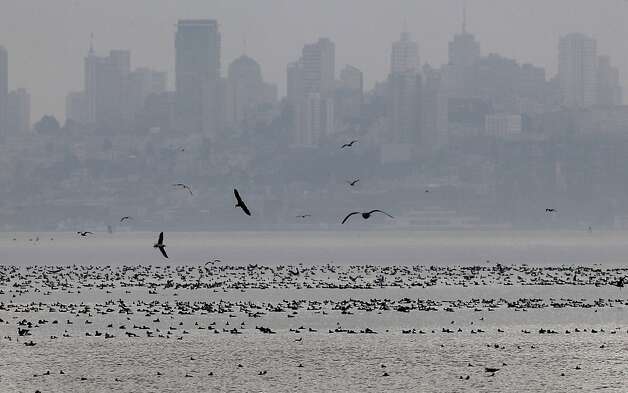
Great swirling schools of herring converged in San Francisco Bay this month, drawing fishermen, sea lions, harbor seals and thousands upon thousands of birds looking to fatten up for the winter.
The
menagerie of wildlife is a sign that the bay's once spectacular herring runs,
which collapsed four years ago, are returning to their former glory. The San
Francisco run is the last urban fishery in the United States in which people
can actually sit on shore and watch commercial boats haul in the squiggling
fish.
As
many as 12,000 birds converged on Richardson Bay, in Marin County, this week as
the herring arrived en masse to lay and fertilize eggs, or roe, a delicacy for
a wide variety of species, including sushi-loving humans. Fishermen scrambled
to cast their nets amid the swooping, honking, squawking hordes.
"It
is such an inspiration. There is something electric about a herring run,"
said Anna Weinstein,
the seabird program manager for Audubon California. "To have such an
exciting event, especially here in San Francisco, is really cool and
exciting."
The
herring, which live up to nine years and can grow to more than 12 inches long,
spend most of their lives in the open ocean.
They
come to spawn in the bay and its estuaries in November, where they congregate
in masses that, if they were all netted, would weigh more than 50,000 tons,
experts calculate.
The
females lay their eggs on rocks, seaweed, riprap or pilings, and the males
fertilize the eggs with their milt.
Near Mission Rock
The
schooling fish were first spotted Jan. 7 off Mission Rock, near AT&T Park.
Hundreds of thousands of the little fish filled the bay from the ballpark to
the Ferry Building over the course of a week, said Ryan Bartling,
an environmental scientist who specializes in marine fisheries for the California Department
of Fish and Wildlife.
The
latest swarm started along the Sausalito waterfront last Friday, attracting
fishermen from as far away as Washington.
"I've
been working on herring for the past decade, and it seems like more people are
taking an interest in them," Bartling said.
"This
week, they were in Sausalito, and it was something to see. When you've got a
30-foot 'bow picker' fishing boat with birds all over, you can't miss it."
The
Pacific herring fishery is important mainly for the product the fish produce, a
delicacy known as golden roe, which is prized in Japan above herring eggs from
other parts of the world because of its brilliant color and taste.
Fishermen
generally cut the roe out of the fish or pluck it off kelp where the herring
spawn. The remains of fish taken for their roe are used for pet food and
chicken feed.
Near catastrophe
The
arrival of the herring is a big thing, Bartling said, particularly in the wake
of their nearly catastrophic decline. The number of herring seen in the bay
dropped steadily starting in the late 1990s and reached a historic low in 2009,
forcing the state to close the fishing season for the winter.
Scientists
believe warmer water and a lack of krill and other food sources in the ocean
caused the decline.
The
arrival of herring is good for the fishing and sushi industries, but it is a
bonanza for the marine ecosystem, where the herring are a crucial cog in the
food chain, Weinstein said. Harbor seals, sea lions, porpoises, dolphins, brown
pelicans, 11 species of seagulls, cormorants, scaups, scoters and grebes rush
from all directions into San Francisco Bay to feast on fish and eggs during the
herring run.
"It
is the biggest estuarine wildlife event in the winter in California,"
Weinstein said.
"Everyone
drops everything and feeds on herring roe. You'll see these fat gulls sitting
there. It looks like Thanksgiving
just happened."
Herring season
This
winter's herring season, which began in November and is open from 5 p.m. Sunday
to noon Friday through March, has a quota of 2,854 tons of fish and roe, or 4.7
percent of the estimated weight of all of the spawning herring in the bay. In
2000, the herring quota was 5,925 tons.
As it
is, Weinstein said, most of the herring in the bay are under the age of 4. The
older, more valuable, fish have almost disappeared. Even the number of
4-year-old fish caught in the bay is well below the historic average, according
to state biologists.
"We're
deeply concerned, as is the Department of Fish and
Wildlife and fishermen, about the lack of older fish,"
Weinstein said. "It indicates stress, but the reason is a mystery."
Peter
Fimrite is a San Francisco Chronicle
staff writer. E-mail: pfimrite@sfchronicle.com
Twitter: @pfimrite
Subscribe to:
Posts (Atom)